
“The last 20% was everything”: Mike Rondaij on how LLMs completed the automation of LC document checking
For a century, documentary credit examination has barely changed. In the past six months, Conpend says it has closed nearly all of the gap that kept full automation out of reach. In this interview, Mike Rondaij, Lead AI Product Solutions Architect at Conpend and co-author of Trade AI, explains why the final stretch was so hard, how large language models made the difference, and why the doc checker matters more now, not less.
Ten years ago, he joined Conpend and set out, together with Marc Smith, to automate one of the most labour-intensive crafts in trade finance: checking documents presented under letters of credit. With Trade Agent, the document examination engine inside Trade AI, he believes that goal is now within reach.
All images in this article are AI-generated illustrations.
A century-old craft, brought into the future
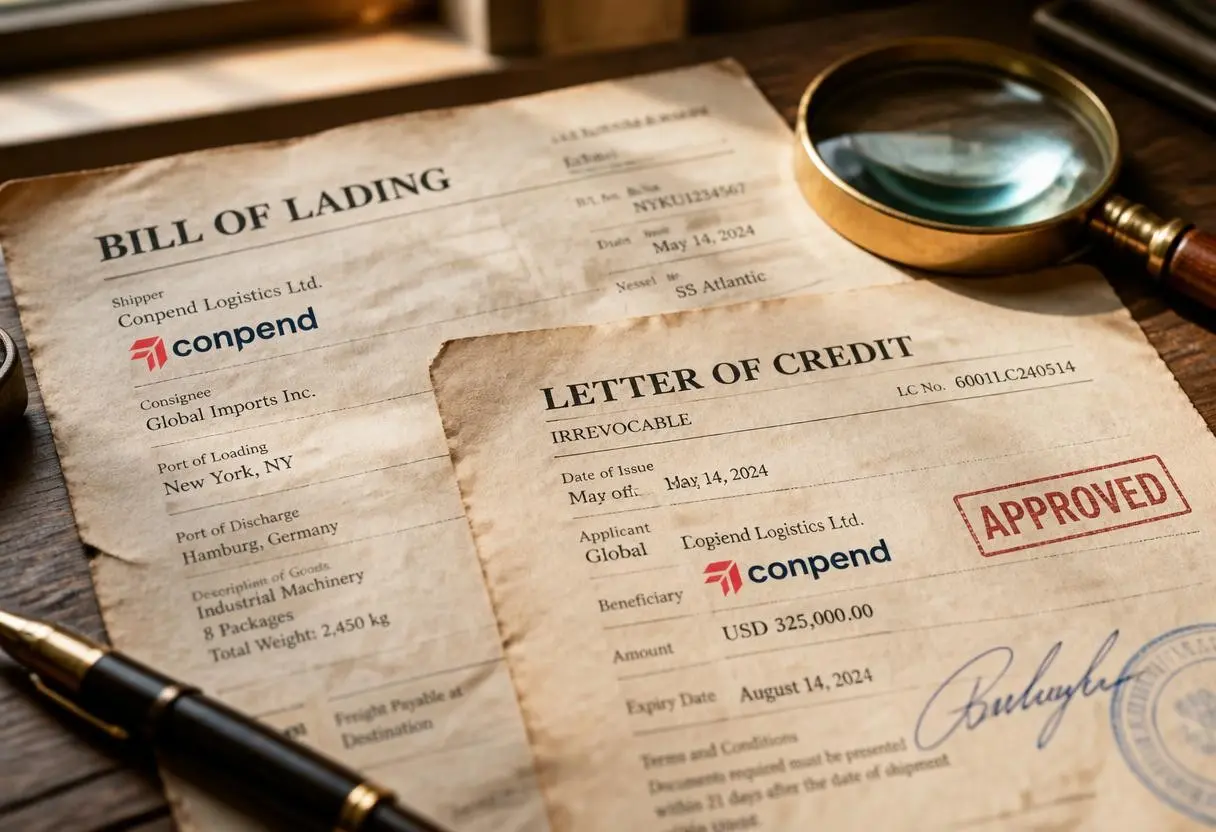
You describe LC document checking as a craft that barely changed in a hundred years. What do you mean by that?
A skilled checker takes the credit, takes the documents, and examines one against the other, line by line, against UCP 600 and the international standard banking practice that grew around it, today ISBP 821. Telex became SWIFT and paper partly became PDF, but the craft itself barely changed. In the last six months, at Conpend, it did.
Conpend didn't start with LLMs, though.
No, and that is important. We started roughly ten years ago and spent most of that decade on the unglamorous groundwork of automating trade finance. Document classification, OCR and data extraction, field refinement and normalisation, interpretation of MT700-series SWIFT messages, sanctions and compliance screening, vessel checks, and a rule-based examination engine mapped article by article to UCP 600 and ISBP 821.
Who built all of that?
A rare combination: talented developers working side by side with trade finance practitioners who bring more than 40 years of domain expertise, and of course our early adopter clients. That took us to the classic 80/20 point. The large majority of standard checks were automated reliably and with a full audit trail: amounts, dates, presentation periods, parties, transport data and consistency between documents.
Why the last 20% was everything

80% automation sounds like a strong result. Why wasn't it enough?
Because the remaining 20% proved to be the hardest part, and arguably the most important. It is where the craft lives: the additional conditions in field 47A, the individual documentary requirements in 46A, goods descriptions that must correspond rather than mirror, and data scattered across several documents. These requirements are mostly ad hoc, written in free text and unique to one transaction. No rulebook of fields and values can anticipate them.
So what did that mean in practice for banks?
Here is the uncomfortable truth our industry has lived with: automating 80% of the checks does not remove 80% of the work. If a human still has to perform the last 20%, they still open the file, read every document and rebuild the full picture of the transaction. That final fifth kept the whole examination on the checker's desk and capped the value of everything automated before it. That was true for every solution in the market, including the most advanced ones.
How LLMs bridged the final gap

What did large language models bring that rules could not?
The ability to read a requirement written in free text and understand what it actually asks for. Trade Agent now does two things that were out of reach before.
- It interprets free-format, transaction-specific requirements, such as additional conditions, documentary stipulations and goods descriptions, and turns them into concrete checks against the presented documents.
- It judges whether the documents meet those requirements, reasoning across documents rather than field by field, down to the presence of a signature and the capacity in which a document is signed.
Banks are wary of AI that hallucinates. How do you deal with that?
The hard part was never getting an LLM to produce an answer. It was getting it to produce the correct answer: the same, defensible answer every time, without hallucinating. We solved that with a hybrid design. Structured data that is reliably extracted stays with deterministic, rule-based checks that we developed over the last decade. The LLM is used only where interpretation is genuinely required, and it is kept on a short leash: it works from the documents in front of it and the rules that apply, not from imagination.
And auditability?
Every finding remains traceable in a full audit trail. And manual data refinement has gone from a mandatory step on every case to an exception, used only when it is truly needed.
A symbiosis, not a shortcut
Couldn't any vendor now plug an LLM into document checking and get the same result?
LLMs alone would not have done this. A general-purpose model knows what a bill of lading is. It does not know how an experienced checker weighs a conflicting date, a vague goods description or an unusual condition, nor what a bank or corporate can live with in practice.
So where does the difference come from?
From the combination. Our domain experts decided what must be checked, how, and where an LLM may and may not be used. Our developers built the engine that enforces those choices. The model brings reading and reasoning at scale; our people bring the judgement about where that reasoning can be trusted.

More than document checking
This conversation has focused on UCP 600. Is document examination all that Trade Agent does?
No, and I want to be clear about that. Checking documents against the credit is only half of the picture. A presentation can be perfectly compliant under UCP 600 and still be a transaction no bank should touch.
That is why compliance is built into the same flow. Alongside document examination, Conpend's applications screen every transaction for sanctions, AML and KYC risk, check the vessels, and soon the containers, involved, flag dual-use goods, and run price checks to spot over- or under-invoicing, a classic signal of trade-based money laundering.
The philosophy is the same as for document checking: deterministic rules where the data is structured, AI where interpretation is needed, and an expert who makes the final call. In practice, the document checker and the compliance officer look at one transaction from two angles, and we want both to have the full picture in one place.
From a blank canvas north of Amsterdam
How did this journey begin?
Ten years ago, Marc Smith approached me and asked how I would feel about automating trade finance operations. I like a challenge, so I accepted. A week later we sat in a meeting room in a hotel north of Amsterdam with two local developers and a blank canvas. The dream was easy to say and hard to build: document examination that is fast, consistent and complete, so that trade finance professionals can spend their time on what only they can do. We soon realised that compliance had to be part of the picture as well.
And where are you today?
Ten years of hands-on automation brought us close. The last six months brought us almost all the way. Today we can finally present and deliver that dream to the banks and corporates we work with.
And let me be clear about who made that possible. Today, it is a young, very dedicated and hard-working team that is enabling all of these changes: the people who turn ideas into working software, test it against real transactions and keep raising the bar every day. We started the journey with only a few people, but today they are the ones taking it over the finish line.
Is the job done?
To be clear, we are not at 100% yet. We are at 98%. A small number of challenges remain, and our team is working on them right now. Given how far we have come in six months, we are very confident we will bridge that final gap in the coming months.
The doc checker stays in charge
The obvious question: does this make the doc checker redundant?
No. Despite everything we have achieved, none of this means we are taking over the doc checker's most important task. Trade Agent does the dirty work: the complex, line-by-line examination. What matters most remains in human hands, which is considering each discrepancy and judging it.
What does that judgement involve?
Is it a false positive? Is it something that can be resolved internally? Or is it a real discrepancy, and if so, how severe is it in the light of this transaction, the market, and the current situation of the customers involved? That judgement depends on context, relationships and experience that no model should own.
So the checker stays in charge. Trade Agent delivers the findings, the evidence and the reasoning, with the full examination visible and auditable. The checker makes the call. We have not replaced the doc checker; we have given them back their time, so they can focus on what really matters: their expertise.
Doing more with scarce expertise
Still, this must be a significant efficiency gain for banks?
Absolutely. Even with the checker making the final call, the efficiency gain is major. A bank can handle the same volume with fewer specialists, or grow its business with the same team.
That matters more than ever. Trade volumes keep growing, while experienced document checkers are becoming scarce as a generation of specialists approaches retirement. For any bank, being able to do more with the expertise it has is a huge benefit.
What does this mean for the next generation in trade finance?
That is one more opportunity, and it matters for the future of our industry. Today, document checking is largely the domain of experienced, seasoned professionals. Their knowledge is invaluable, but the craft has rarely been seen as an exciting career for young talent.
State-of-the-art AI changes that picture. A new generation can now step into a role where deep domain expertise meets cutting-edge technology, learning the craft from experienced colleagues while working with the tools of the future. That brings document examination into the 21st century, and helps make sure that decades of expertise are passed on rather than lost.
Early users, early findings
Are there live users of Trade Agent today, and what are they finding?
Yes. A number of clients are already using Trade Agent, and the interest from the market has been enormous.
Their findings so far have been overwhelmingly positive. But we are a data-driven company, and we don't draw conclusions from first impressions. We want to give it a longer run, across more transactions, more document types and more banks, before we make claims or come with a final verdict. When we do, it will be backed by numbers.
Ready for paper, ready for digital
Trade is going digital. Where does Trade Agent stand in that future?
Let's be realistic first. A great deal of trade, if not the majority, still runs on paper: original bills of lading, stamped certificates, signed invoices. We expect that to remain the case for a few more years. So we have to be excellent at paper, and we are: scanned documents are classified, read and examined like any other presentation.
But we are equally ready for what comes next. Trade AI already digests structured data through APIs, XML and digital documents. When electronic bills of lading and other digital trade documents gain real traction, helped by legal frameworks such as MLETR, we will be ready for them. The same goes for smart contracts and supply chain technology.
For us it doesn't matter how a document arrives, on paper or as data. What matters is that it is examined correctly. Paper today, digital tomorrow: the checker gets the same complete picture either way.
A legacy that lives on
Last question. After more than 40 years in trade finance, what does this mean to you personally?
I started in 1985 as a rookie in a documentary credit operations department. If you had told me then that one day I would be at the root of a movement that would change the game itself, I would probably have laughed and called you crazy.
My own retirement is about seven years away. When people like me leave, decades of knowledge risk leaving with us: the instinct for a doubtful clause, the feel for what a bank can live with, the lessons learned the hard way. My wish is that this knowledge is preserved and passed on, to the young team I work with today and the colleagues who come after them, and even through an application that lives on long after I have stepped back to do pleasantly unimportant things.

About Mike Rondaij
Mike Rondaij is Lead AI Product Solutions Architect at Conpend. He brings more than 40 years of experience in trade finance, corporate banking and enterprise banking technology, from operational banking and documentary credit expertise to large-scale transformation projects for Deutsche Bank, ING, ABN AMRO, Bank Leumi Panama, Santander, UniCredit, Credit Europe Bank, MeesPierson and Commerzbank, and for software vendors Temenos and Finastra.
As a founding member of Conpend and co-author of Trade AI, Mike started the Trade AI journey with Marc Smith ten years ago and has driven the product's evolution ever since. Today he architects AI-enabled solutions for trade finance and corporate banking, from documentary credit digitalisation and compliance intelligence to human-in-the-loop AI systems. His conviction: AI should amplify domain expertise, not replace it.